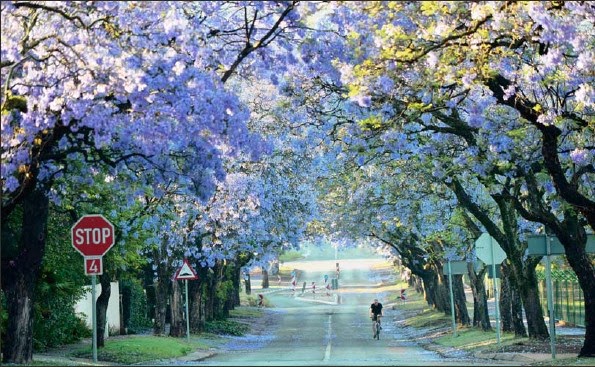
Reproduced from Rosa Swanepoel's Pretoria Nuusbrief of August 2012
Compiled by Charles Els, Pretoria, March 2012
This extract from Rosa's August 2012 newsletter provides background to rich history behind the original street names.
ANDRIES changes to THABO SEHUME
Andries Street: Central
Andries Street was named after the Voortrekker leader
General Andries Wilhelmus Jacobus Pretorius (1798 – 1853). He was the hero of
the Battle of Blood River (1838) and father of President Marthinus Wessel
Pretorius (1819 – 1901), founder of Pretoria.
Soon
after the founding of Pretoria
in 1855, maps appeared showing the street as St Andries Street. There is much
speculation about this. Some maintain that the ‘St’ was an abbreviation of
Stephanus, the first name of Commandant-General Stephanus Schoeman (1810 –
1890), Acting President of the South African Republic, who lived at Klein
Schoemansdal at the northern extremity of the street where the National Cultural History
Museum now is in Boom Street.
Others
say that the name was derived from the so called ‘kruisvlag’ (‘crossed flag’),
a blue flag with a red saltire similar to the flag of St Andrew. This
Voortrekker flag was supposed to have been the flag of those Voortrekkers who
had followed Potgieter. The prefix ‘St’ was dropped during the Voortrekker
centenary celebrations in 1938.
Thabo Sehume
THABO Sehume, was a Black Consciousness Movement (BCM) and Azapo stalwart, a community worker and leader, a shrewd trade unionist, an uncompromising political activist, an irrepressible and devastating political opponent, an ideologue and visionary and, above all, a revolutionary intellectual.
Sehume loomed large over the security apparatuses of the apartheid regime and handled with mocking impatience those who pretended to represent the true interests of the oppressed black people.
For this reason, he was banned and house-arrested, subjected to countless detentions without trial and was always a must in the list of those to be apprehended in Atteridgeville, Tshwane .
BEATRIX/MEARS/VOORTREKKER to change to STEVE BIKO
Beatrix Street: Arcadia
The Dutch Government now objects not only to the
proposed change of the name of Queen Wilhelmina Road which is, indeed, named
after Queen Wilhelmina
Helena Pauline Maria of the Netherlands (See “Queen Wilhelmina Road” below) but
also to the proposed change of the name Beatrix Street, probably under the
impression that it is named after Queen Beatrix Wilhelmina Armgard, their reigning Queen.
Beatrix Street, however, was named after Beatrix Dorey Meintjes (1885),
eldest daughter of Edward Philip Arnold (Eddie) Meintjes (1861), son of Stephanus Jacobus Meintjes (1819-1887). Meintjes Street,
Sunnyside, was called after Eddie Meintjes.
Stephanus
Jacobus Meintjes (1819-1887) was an Attorney and later an Advocate of
the Supreme Court. He was the owner of Trevenna Estate, which now forms part of Sunnyside.
He purchased the farm Arcadia, which he divided
into erven. The hill on the farm, Meintjeskop was named after him. He erected the town’s
first mill on the banks of the Apies
River at Lion Drift
(Bridge) in Church Street.
The land around Meintjeskop was bought by the Government in 1909 for
£32 500 and the City Council donated a further portion own by them, valued
at £25 000 for the erection of the Union Buildings on the site described
by Lord Selborne (1859-1942) as “one of the finest in the world”. Meintjes
square (now a small park) situated on the corner of Park and Beatrix Streets
was first known as Arcadia Square and renamed by the City Council to honour
Meintjes Sr.
Stephen Bantu Biko (18 December 1946 – 12 September 1977) was an anti-apartheid activist in South Africa in the 1960s and 1970s.
A student leader, he later founded the Black Consciousness Movement which would empower and mobilize much of the urban black population. Since his death in police custody, he has been called a martyr of the anti-apartheid movement. While living, his writings and activism attempted to empower black people, and he was famous for his slogan "black is beautiful", which he described as meaning: "man, you are okay as you are, begin to look upon yourself as a human being".
Even though Biko was never a member of African National Congress (ANC), ANC has included him in the pantheon of struggle heroes, going as far as using his image for campaign posters in South Africa's first non-racial elections in 1994. Nelson Mandela said of Biko: "They had to kill him to prolong the life of apartheid." Mears Street
Named
after James Edward Mears who arrived
in Durban from London in 1840; he married Johanna Raats, a
cousin of Voortrekker Gerrit Maritz. Mears came to Pretoria
in the 1870's and purchased a portion of the farm Elandspoort on which he laid
out Pretoria's
first suburb, Sunnyside, in 1875. In the early 1880's he also owned a farm in
the Boshoff district, Free State,
where he bred horses.
Divorcing
his Voortrekker wife, he remarried against the family wishes and left for England to
further his business interests and had an extended honeymoon travelling the
continent for a few years. On his return to Pretoria in 1903, he was a stranger to his
family and friends and found that his assets were sold to pay his debts. He
died and was buried as a pauper in the Brixton cemetery in Johannesburg. His son, Commandant Mears,
served in the Boer service during the Second Anglo-Boer War (1899-1902) and
married into the Moodie family that founded Melsetter in Rhodesia (Zimbabwe).
Voortrekkers Road: Wonderboom South, Mayville, Gezina, Capital Park
Voortrekkers Road is the main arterial route from
Prinshof to where it passes the neck at the Wonderboom reserve from where the
street took its name, which in turn was christened during the Van Riebeeck
tercentenary celebrations in 1952.
CHARLES / WALKER to change to JUSTICE
MOHAMMED
Charles Street: Brooklyn
Charles Street is
called after Charles Marais, son of “Ryk” Lang Piet Marais. Charles was a land
surveyor associated with township development. He laid out and surveyed Brooklyn. Both Charles and Marais Street in Brooklyn
are called after him. May Street in Brooklyn
is called after his wife Catherine May Venitia Emmitt. He also laid out and
surveyed Silverton.
Rupert Street in Brooklyn is called after his brother, Rupert Ford Marais.
He was an Attorney, partner in the firm S W Pienaar, solicitors, who had an
interest in the establishment of Brooklyn.
Rupert later became an Advocate of the Supreme Court. Stella Street here was named for his
wife.
Justice Ismail Mahomed, SCOB S.C. (5 July 1931 - 17 June
2000) was a South African lawyer who served as the Chief Justice of South
Africa and the Supreme Court of Namibia, and co-authored the constitution of
Namibia.
Mahomed was refused admission to the Pretoria Bar
Association, as it was reserved for white lawyers, but was able to join the Johannesburg
Bar Association. However, because of the Group Areas Act, he was banned from
getting an office of his own, and was forced to practice out of his colleagues'
offices while they were away. In the 1960s he served as a lawyer in Botswana.
Lesotho, Swaziland and Zimbabwe. In 1974 he became the first non-white in South
African history to take silk. In 1979 he was appointed to the appeal court of
Swaziland and in 1982 was made an Appeal Judge in Lesotho, where he would later
become president of the Appeals court. He was made an English Barrister in
1984. In 1991 he became the chair of the Convention for a Democratic South
Africa and the country's first non-white judge of the Supreme Court of South
Africa. He was later appointed to the Appeal Court. He was made a judge of the Constitutional
Court in 1995. In 1996 he was made the Chief Justice of South Africa by
President Nelson Mandela.
Walker Spruit/Street: Sunnyside
The stream rises in Nieuw Muckleneuk and is dammed at Magnolia Dell creating a children's pool, it then flows on to join the Apies River at Lion Bridge in Church Street.
What becomes Walker Street, starts off as Jacob Mare Street in the west, then becomes Rissik Street at Victoria Bridge near Van Boeschoten Avenue, and then becomes Walker Street from the Bourke Street intersection.
The Walker family left Natal to settle in Pretoria in 1868. Arthur Hamilton Walker and his son Mackenzie Harry were both surveyors. Arthur re-surveyed the Pretoria Township originally laid out by Andries Francois du Toit. Mackie (Mackenzie) worked in the government surveyor's office. He was born in Pietermaritzburg in 1848, married Augusta White and settled south of Sunnyside on the upper ridges of the farm Elandspoort which he had purchased in the 1870's.
He laid out Muckleneuk and Nieuw Muckleneuk. Bailey's Muckleneuk was established on ground that he sold off. He also surveyed Mayville in 1896. Mackie retired to his farm Klippan on the Springbok Flats, north of Pretoria, where he died in 1927 at the age of 78 years. Walker, Mackie, Sidney and White Streets and Walker Spruit were named after the family.
CHURCH STREET will now be changed to four different names:
- From Nelson Mandela to the East it changes to STANZA BOPAPE
- From Nelson Mandela to Church Square changes to HELEN JOSEPH
- From Church Square to R511 it changes to W F NKOMO
- From R511 to the West changes to ELIAS MOTSWALEDI
Church Street: Central
Church Street is approximately 12km long. The section between Colbyn in the east,
and Atteridgeville in the west, is considered to be the longest straight street
in the Republic. It will be noticed that the streets in the centre of old Pretoria are wider than
other streets. Surveyor Andries Francois du Toit was instructed to plan them so
as to allow an ox-wagon with a full span of 16 oxen to make a U-turn if
necessary.
The name Church Street was
derived from the fact that the first church was built on Church Square (by two Vermeulen brothers;
see Vermeulen Street
below).The church was known as the “Philadelphia Broederschap” (Philadelphia
Brotherhood).
Stanza Bopape was born on 26 April 1961 in Mamelodi East. He began high school studies at Rebalelaka Secondary. He decided to move to Mamelodi High where he became politically aware. He joined South African Students’ Organisation and the local African National Congress Youth League branch. After matriculating he became involved in his community and was elected in 1987 as the first General Secretary of the South African National Civic Organisation (SANCO) in Mamelodi.
Believed to be a ‘security’ threat, the Security Police accused him of being a communist and a dangerous influence. Despite being on the run, he managed to mobilize and organize people against apartheid. The police threatened his family almost daily even with death in their efforts to capture him. On 10 June 1988, Bopape was finally arrested by the police. He was taken to John Vorster Square where he was brutally tortured along with, together with Murphy Morobe, a young activist from Soweto. He died on 12 June 1988, while in police custody.
Helen Joseph was born in Easebourne near Midhurst West
Sussex, England and graduated from King's College London, in 1927. After
working as a teacher in India for three years, Helen came to South Africa in
1931, where she met and married a dentist, Billie Joseph. She served in the
Women's Auxiliary Air Force during World War II as an information and welfare
officer. After the war and her divorce she trained as a social worker and
started working in a community centre in a Coloured (mixed race) area of Cape
Town.
In 1951 Helen took a job with the Garment Workers Union, led
by Solly Sachs. She was a founder member of the Congress of Democrats, and one
of the leaders who read out clauses of the Freedom Charter at the Congress of
the People in Kliptown in 1955. Appalled by the plight of black women, she was
pivotal in the formation of the Federation of South African Women and with the
organisation's leadership, spearheaded a march of 20,000 women to the Union
Buildings in Pretoria to protest against pass laws on August 9, 1956. This day
is still celebrated as South Africa's Women's Day.
William Frederick Nkomo was born in Makapanstad near
Pretoria in 1915. He was the son of a Methodist minister, Abraham Nkomo, and
attended primary school in Mafikeng and Klerksdorp. His secondary education
took place at St Peter’s School in Rosettenville, Johannesburg and he
matriculated at the Healdtown Institute near Fort Beaufort in the Eastern Cape.
Elias
Motsoaledi was born on 26 July 1924 in Phokoane in the Nebo District in Limpopo
He moved to Johannesburg at the age of 17. His first brush with the law in
Johannesburg was his arrest for failure to produce his pass book – he was
sentenced to work on a pretoria road construction. Upon his release he got a
job in a furniture factory.
He joined the
Leather Workers' Union, served on the Committee of Non-European Trade Unions, and
later played an active role in the establishment of the South African Congress
of Trade Unions.
In 1948 he
joined ANC, in June he was elected as a branch secretary. He was a member of
the South African Communist Party. He played a central role in many campaigns,
including the Defiance Campaign of 1952, the year in which he was first banned.
He was imprisoned for four months during the 1960 State of Emergency
D
F MALAN to change to E’SKIA MPHAHLELE
D F Malan Drive: Pretoria
West/ Roseville/ Parktown/ Hermanstad/ Mountain View
Previously
called Lorentz Street,
the street was renamed to honour the South African clergyman and statesman
Daniël Francois Malan (1874-1959).
Malan was born in Riebeeck-West in
the Cape Colony. He obtained a B.A. in Music and
Science from the Victoria
College in Stellenbosch
and entered the teaching profession. After
leaving teaching he entered the Stellenbosch seminary in order to train
as a minister in the Dutch Reformed Church. He
entered the ministry and served at Heidelberg
(Tvl.), Montague and Graaff-Reinet. Along with his studies in theology,
he obtained a M.A. in Philosophy from Victoria
College (later to be the Paul Roos
Gymnasium and the Stellenbosch
University). Malan left South Africa in 1900 to study towards a
Doctorate in Divinity at the University
of Utrecht, which he
obtained in 1905. He took part in the
founding of the Zuid-Afrikaanse Akademie voor Taal,
Letteren en Kunst.
He
founded the political National Party. The party came to power on the program of
apartheid and began its comprehensive implementation. He is seen as a champion
of Afrikaner nationalism. He became Prime Minister of the Union National Party
government in 1948 and
remain Prime Minister until 1954 when he retired.
Es'kia
Mphahlele (17 December 1919 – 27 October 2008) was a South African writer,
educationist, artist and activist. He was born Ezekiel Mphahlele but changed
his name to Es'kia in 1977. He is celebrated as the Father of Afrikan Humanism.
He was one of the founding figures of modern African literature. His journey
from childhood in the slums of Pretoria to literary icon was an odyssey both
intellectually and politically. As a writer, he brought his own experiences in
and outside South Africa to bear on his short stories, fiction, autobiography
and history, developing the concept of African humanism. He skilfully evoked
the black experience under apartheid in Down Second Avenue (1959). It recounted
his struggle to get an education and the setbacks he experienced in his
teaching career. Mphahlele was an illustrious author of two autobiographies,
more than 30 short stories, two verse plays and a number of poems. He is deemed
as the "Dean of Afrikan Letters".
DUNCAN changes to JAN SHOBA
Duncan Street: Hatfield
Prior
to 1930 this street had four names along its length. From Church Street to the swimming pool it was
Duncan; the short curve at the baths was known
as Nixon; then it became Duncan again as far as Lunnon Road; finally
it became James Street
- after Mr. James Brooks who established Brooklyn Township.
The
City Council bought portions of the properties and straightened the road
somewhat and named the entire stretch Duncan
Street, after Sir Patrick Duncan.
Patrick
Duncan, K. C. (1870-1943) was born in Scotland and was chosen as private
secretary to Sir Alfred Milner (1854-1925) in 1895. He was also Treasurer of
the Transvaal from 1901 to 1903, Colonial Secretary of the Transvaal
from 1903 to 1907 and represented Fordsburg in Parliament from 1910 to 1920. He
became Minister of Interior, Education and Public Works in 1921 and held these
portfolios until 1924. From 1933-1936
Sir Patrick was Minister of Mines.
He was the
first South African Governor-General
of the Union of
South Africa from 1936 until his death in
1943. His ashes were interred in the granite block at Duncan Dock in Cape Town, which was also
named after him.
Jan Shoba was
a leader in the Azanian People's Liberation Army, the armed wing of the Pan
Africanist Congress (PAC). He was a member of their High Command. In the late
1980s the military wing (APLA) of the PAC was disbanded and their focus became
political and social issues.
Jan Shoba was
arrested in 1984 and placed in Robben Island Prison. He managed to get the
prison authorities to agree to a delivery of the Zimbabwean daily The Herald.
He was thus able to supply the PAC on Robben Island with valuable information
regarding political developments.
In 1990,
following the negotiated Harare Declaration he was released from jail. He was
placed in charge of party security, which may have played a part in his demise.
In a Truth
and Reconciliation report it was stated that Jan Shoba trained members of the
PAC in the use of firearms in June 1991. At the time the PAC developed the
"Great Storm" operation, designed to instill fear in farmers.
Jan Shoba's
possible involvement in the "Great Storm" could be the reason for his
demise. He was assassinated outside his yard in Atteridgeville - his killers
are still unknown.
ESSELEN changes to ROBERT SOBUKWE
Esselen Street: Sunnyside
It is
generally accepted that this name commemorates Ewald August Esselen, jurist and
politician (1858-1918), who owned portion of the ground on which Trevenna Township was established. He was born in the Cape
Colony and arrived in the Transvaal soon after the First Anglo-Boer War (1881). He
became a judge in the South African Republic in 1887 and resigned in 1890 to
become a Member of the Second Volksraad for Potchefstroom in 1891. He was a
member of the First Volksraad of the South African Republic in 1893. Esselen
was Attorney-General during 1894 and 1895.
During
the Second Anglo-Boer War he served as legal adviser on General Piet J
Joubert's staff. In 1904 he became one of the founders of the Het Volk Party
and in 1907 became a member of the Transvaal Legislative Council. He died at
Sea Point (Cape Town)
and was buried in the old Church
Street cemetery.
Robert
Mangaliso Sobukwe (5 December 1924-27 February 1978) was a South African
political dissident, who founded the Pan Africanist Congress in opposition to
South Africa under apartheid. In 2004 Sobukwe was voted 42nd in the SABC3's
Great South Africans.
Sobukwe was
born in Graaff-Reinet in the Cape Province on the 5 December 1924. He came from
a poor household and was educated locally. He attended a Methodist college at
Healdtown and later Fort Hare University where he joined the African National
Congress
In 1952
Sobukwe achieved notoriety backing the Defiance Campaign. He identified with
the Africanists within the African National Congress and in 1957 left the ANC
to become Editor of The Africanist newspaper in Johannesburg.
He was a
strong believer in an Africanist future for South Africa and rejected any model
suggesting working with anyone other than Africans, defining African as anyone
who lives in and pays his allegiance to Africa and who is prepared to subject
himself to African majority rule. He later left the ANC to form the Pan
Africanist Congress (PAC), and was elected its first President in 1959.
GENERAL
LOUIS BOTHA changes to JANUARY MASILELA
General Louis Botha Drive: Lynnwood Glen, Lynnwood Ridge, Lynnwood Park, Menlyn, Waterkloof Glen,
Garsfontein
Originally
called the old military road made during World War II as a direct link between Roberts Heights (Voortrekkerhoogte Thaba
Tshwane) and Zonderwater military camp near Cullinan.
Annie Botha Street in Riviera was originally called Plein Street, and
then received the name Louis Botha
Avenue as did the Louis Botha Home close by.
General Botha was born in the Greytown district, Natal, in 1862; his birthplace was purchased
by an Indian businessman and donated it to the authorities on condition that
the site be preserved for posterity.
Botha
was elected to the Volksraad in 1897 and was appointed Commandant-General on
the death of General Piet Joubert on 7 May 1900. Botha fought brilliant battles
at Colenso (15 Dec 1899) and Spioenkop (17-24 Jan 1900); Belmont, Stormberg and
Magersfontein. Pretoria fell to the British on 5
June 1900, and he rallied his burghers and fought the British at Diamond Hill
east of Pretoria
and again in the last big battle at Dalmanutha.
Louis
Botha became the first Prime Minister of the Union
(1910). He led the Union Defence forces against German South-West Africa
(1914). On returning home after the signing of the Treaty of Versailles he
became ill and died of pneumonia on 27 August 1919; he was buried in Rebecca Street
cemetery, Pretoria.
January Boy
Masilela (1955 – 2008) is the former
Secretary of Defence for the South African Department of Defence. He also
served as the Deputy Secretary-General of the African national Congress.
HANS
STRIJDOM: proposal to change to SOLOMON MAHLANGU
Hans Strijdom Drive: Equestria, Constantia Park, Erasmuskloof, Faerie Glen, Monument Park,
Wapadrand
Johannes
Gerhardus Strijdom (Strydom) (1893-1958), fifth Prime Minister of South Africa,
born in the Willowmore district, Eastern
Cape. On completion of his studies he went ostrich
farming with the family, then moved to Pretoria
and took up a post in the civil service. He was a member of the ambulance corps
during the S W A Campaign in 1915. In 1918 he established himself as a lawyer
in Nylstroom in the Northern Transvaal.
In
1929 he was elected to parliament and advocated republicanism. He became leader
of the National Party and was South
Africa's fifth Prime Minister, succeeding
Malan. In the 1948 parliament he was called “The Lion of the Waterberg” or “The
Lion of the North” for his uncompromising political views and for being the
only Transvaal supporter of D F Malan’s party.
The J
G Strijdom Tunnel in the Eastern Transvaal was
named after him. A statue of him is found in the engineering faculty building
at the University
of Pretoria. There are still various monuments dedicated to him in South Africa.
One monument which featured a large bust of him on “Strydom Square”
in the Pretoria Central (next to the Volkskas
Building, c/o Schoeman
and van der Walt Streets) collapsed in 2001 injuring two people.
He
died in Cape Town
and was buried in the old cemetery in Church
Street, Pretoria. His house in Modimolle (formerly Nylstroom) is now a museum, which
holds parts of the collapsed bust.
Solomon Kalushi Mahlangu was born in Pretoria on 10 July in 1956. He was the second son of Martha Mahlangu. His father left him in 1962, and from then on only saw him infrequently. His mother was a domestic worker and took sole responsibility for his upbringing. He attended Mamelodi High School up to Standard 8, but did not complete his schooling as a result of the school’s closure due to ongoing riots.
He joined the African Nation Congress (ANC) in September 1976, and left the country to be trained as an Umkhonto we Sizwe (MK) “The Spear of the Nation” soldier. The training was received in Angola and Mozambique and on 11 June 1977 he returned to South Africa as a cadre, heavily armed, through Swaziland to assist with student protests.
On 13 June 1977, Mahlangu and his companions, Mondy Johannes Motloung and George "Lucky" Mahlangu, were accosted by police in Goch Street, Johannesburg. “Lucky” Mahlangu managed to escape, however, in the ensuing gun battle two civilian men were killed and two wounded. Solomon Mahlangu and Motloung were arrested.
Solomon Mahlangu was tried from the 7th of November 1977 to the 1st of March 1978, for charges associated with the attacks in Goch Street in June 1977. He was therefore charged with two counts of murder and several charges under the Terrorism Act. Mahlangu pleaded not guilty to the charges. His council stated that he entered South Africa in June 1977 as part of a group of ten, bringing arms, ammunition, explosives and ANC pamphlets into the country
HENDRIK VERWOERD proposal to change to JOHAN
HEYNS
Hendrik Verwoerd Drive (H F Verwoerd Drive)
Previously called 9th Avenue; the drive extends
from Voortrekkers Road
in the North to Soutpansberg Road
in the South. The name change came about in 1987 to honour the memory of
Hendrik French Verwoerd, former Prime Minister of the Republic.
Hendrik Frensch Verwoerd, often considered the
architect of apartheid, was born in Amsterdam on
8 September 1901, six months before his parents moved to Wynberg, near Cape Town, South
Africa. They then moved to Bulawayo,
Zimbabwe, where the family
lived for five years before moving to Brandfort,
Free State, South
Africa. After completing secondary school in
1918, he went to the University
of Stellenbosch where he
majored in sociology, psychology, and logic. After receiving his B.A., he was
appointed to a position in the Psychology Department, completing his master's
in 1923 and his doctorate in 1924. In 1925 he went to Germany to study at Leipzig,
Hamburg and Berlin. In 1927 he assumed a position as
professor of applied sociology at Stellenbosch, where he became chair of the
Department of Sociology and Social Work in 1933.
Verwoerd joined the Purified Nationalist Party in
1935 and also became a member of the Broederbond. He left academia to establish
the Nationalist paper Die Transvaler in 1937. The major
objective of the paper was to lure Afrikaners away from the British-oriented
United Party and foster the idea of a Christian-National republic. After the
National Party's victory in 1948, the new prime minister, Daniel F. Malan,
appointed Verwoerd to the senate and in 1950 Verwoerd became minister of native
affairs. On the death of J. G. Strijdom, Malan's successor, Verwoerd became
prime minister in 1958.
After organizing a successful referendum to create
a South African republic, Verwoerd attended the Commonwealth Prime Ministers'
Conference in London
in 1961. There he explored the possibility of South
Africa remaining a member of the British
Commonwealth. Although rebuffed by the British, Canadians, and
Afro-Asian bloc because of apartheid, he received a hero's welcome when he
returned to South Africa
in early 1961. Afrikaner Nationalists applauded South Africa's removal from the
commonwealth.
Verwoerd was assassinated on 6 September 1966,
before a parliamentary session in the presence of about four hundred people.
The assassin, Demetrio Tsafendas, was later tried and incarcerated in mental
institutions until his death in 1999. Officially classified white, he had been
born in Mozambique
to a Greek father and a Coloured mother. In a 2001 book Henk van Woerden argued
convincingly that the assassination was politically motivated.
Johan Heyns
Johan Adam Heyns (27 May 1928 – 5 November 1994), was an influential Afrikaner Calvinist theologian and moderator of the general synod of the Nederduits Gereformeerde Kerk (NGK). He was assassinated at his home in Waterkloof Ridge, Pretoria. Although his murder was never officially resolved it is widely believed that it was directly related to his criticism of Apartheid. Nelson Mandela paid homage to him as a martyr for his country and a soldier of peace.
JACOB
MARE changes to JEFF MASEMOLA
Jacob Mare Street: Central
This street has
had many names. Originally it was Maré
Street; in the late 1920's it became Paul Mare Street;
and finally Jacob Maré Street.
Jacob Phillipus Maré (1823-1900) represented Heidelberg in the Transvaal Volksraad from
1875-1877 and again in 1880. In 1880 he became a member of the Transvaal
Executive Council and took part in the peace negotiations at Majuba. In about
1890 he moved to Nazareth
(or Middelburg), South African Republic, for health reasons. He died there on
11 February 1900.
The famous South
African song 'My Sarie Marais' recalls his daughter, Susara Margaretha Maré. It
was composed by J P Toerien when he was in the Cape,
before they were married.
Jeff Masemola
Jafta Kgalabi Masemola, “The Tiger of Azania”, also popularly known as “Bra Jeff” by many others, was born at Bon Accord near Pretoria on 12 December 1931. He lost both his parents at an early age and was raised by his sister. The family moved to Marabastad and then to Atteridgeville in 1942 where he enrolled at De Jong Primary School and completed standard six in 1947. He proceeded to Hofmeyr Secondary School where he obtained a Junior Certificate in 1950. Then he went to Kilnerton Training Institution (KTI) where he completed his Teacher’s Training Certificate.
His first teaching post was in Atteridgeville where he worked on a temporary basis until he got a permanent post at Mmakau Primary School (Rama) in Western Transvaal. In 1956, he returned to Atteridgeville to teach at Banareng Primary School where Rammopo Makhudu was principal.
In 1958, he joined the African National Congress Youth League. In 1959, he joined the Pan Africanist Congress (PAC) of Azania at its inception and was one of its founding members. He intertwined lessons with political education, thus influencing some of the children and as well as his colleagues at his school. As a result, some of his pupils became members of the PAC when they got to high school and were later incarcerated with him on Robben Island in 1963.
After the banning of the PAC on April 8, 1960 under the Unlawful Organizations Act, Masemola and other PAC operatives others were sent out of the country to set up the PAC’s underground guerrilla structure, Poqo in Lesotho. The formed underground structure planned an armed revolt in 1963. They gathered whatever weapons they could find for the planned uprising. The security police uncovered these activities and Masemola and other activists were arrested during a swoop on PAC-Poqo suspects on the night of 21 March 1963.
In June 1963 Masemola appeared in the Pretoria Supreme Court along with 14 others and was charged with conspiracy to commit acts of sabotage and with intention to overthrow the government by violent means. He was convicted and sentenced to imprisonment on Robben Island in 1963.
He spent over 26 years on Robben Island and other prisons. On the Island, Masemola, had access to workshop tools, including a grinding stone. Together with another prisoner, Sedick Isaacs, he devised an escape plan. Masemola crafted a copy of the cell master key, which allowed him to 'sneak' around at night. The plan was to steal medical supplies from the dispensary, dope the wells and put the wardens into deep sleep. Unfortunately, information about the plan was exposed when a common law prisoner leaked the information to the prison wardens. They raided the cells and discovered the key. Both men had an extra year added to their sentence.
Masemola was released on 15 October 1989. On the eve of his release, Nelson Mandela asked to have a meeting with him. Masemola was flown from Johannesburg (Leeukop Prison) to Victor Verster Prison in Cape Town to meet Mandela. Nothing has ever been disclosed about what transpired in that meeting. At his homecoming reception in Atteridgeville, the Super Stadium was filled to capacity. The police intervened and ordered the people to disperse before the function could end.
LEAH MANGOPE changes to PETER MAGANO
Leah Mangope is
the late wife of Lucas Mangope (see below). She died in March 2003.
LUCAS MANGOPE changes to
MOLEFE MAKINTA
Kgosi Lucas
Manyane Mangope
(1923) is the former President of the “independent homeland” (Bantustan) of
Bophuthatswana and current leader of the United Christian Democratic Party, a
minor political party based in the North West Province of South Africa. He
still holds a position in the North-West Provincial Legislature.
He became President of Bophuthatswana in
1977, believing that, by cooperating in the system of Grand Apartheid, he could
bring benefits to the Batswana people of South Africa; a stance that placed
him in a precarious and often contradictory position throughout most of his
political life. Some considered him a puppet of the South African government
during his presidency.
In 1988 he was awarded an honorary Doctorate
degree by the former University
of Bophuthatswana. In the
same year he was briefly overthrown by members of a military police unit and
was reinstated following intervention by the South African Defence Force. South Africa's
government stated that it was responding to a request for assistance from the
legal government of a sovereign nation.
Bophuthatswana collapsed after political chaos
ensued in March 1994. Not even the intervention of the Afrikaner Volksfront and
the militarized Afrikaner Weerstandbeweging (AWB) could save Mangope’s Bophuthatswana.
It the Kempton Park
negotiations in 1993 that led to the first non-racial elections in South Africa in 1994, Mangope had made it clear
that Bophuthatswana would remain
independent of the new and integrated South Africa and that he would not
allow the upcoming elections to take place in "his country". With
most residents in favour of reintegration, his defense force mutinied and
although Mangope called on outside help he was eventually forced to flee the
homeland. Shortly thereafter, the homelands were reincorporated into South Africa
MICHAEL
BRINK changes to NICO SMITH
Michael Brink
Park: Sunnyside
This
park was originally called Kruger
Square, after President Paul Kruger. The name was
changed to Michael Brink Park
to avoid confusion with the Kruger
Park between Mitchell,
Rose-Etta, Soutter and Court Streets in Pretoria West.
Johannes
Michael van Helsdingen Brink was born at Colesberg in the Cape Colony
in 1889. He lived in Rietfontein for more than 25 years and was mayor of
Innesdale for nine years and later a member of the Provincial Council.
MITCHELL changes to CHARLOTTE MAXEKE
Mitchell Street: Pretoria
West
Named after George Mitchell, of Edinburgh, Scotland,
father-in-law of John Lyall Soutter, the land surveyor associated with the
laying out of a portion of Pretoria West. Soutter was
born in Edenburg, Scotland
in 1864 but came to Transvaal in 1888. He
became principal clerk at the Surveyor-General’s office.
PAUL
KRUGER STREET AND PRETORIUS
names TO BE RETAINED
Paul Kruger Street: Central
Paul Kruger Street was originally called Markt (Market) Street, but the name was
changed during the Voortrekker celebrations in 1938 to commemorate State
President Stephanus Johannes Paulus Kruger (1825-1904) who held office from
1883 to 1902.
Kruger was born
at Bulhoek in the Cradock district of the Cape Colony
on 10 October 1825. As a twelve-year-old youth he accompanied his family on the
Potgieter Trek from the Cape. He first settled
in Schoemansdal in the Zoutpansberg.
In terms of
Republican law, Paul Kruger was allowed two farms; he acquired Waterkloof and
Boekenhoutfontein in the Rustenburg district in 1842. The homestead and
buildings on Boekenhoutfontein have been restored and are open to visitors.
Kruger married
twice: Maria du Plessis, his first wife, passed away in 1846; his second wife,
Gezina Susanna Frederika Wilhelmina du Plessis (1831-1901), was a cousin of his
first wife. The township
of Gezina was called
after her, as was Frederika Street
in that township.
Paul Kruger
became Veldkornet (Field Cornet) in 1851 and Commandant in 1854, was a member
of the triumvirate government during the first Anglo-Boer War (1880-1881) and
served four terms (1883-1902) as President of the Zuid-Afrikaanse Republiek
(ZAR).
The Second Boer War (Afrikaans: Tweede Vryheidsoorlog) was fought from 11 October 1899 until 31 May 1902 between the
British Empire and the two independent Boer republics, the ZAR (South African
Republic/Transvaal Republic) and the Orange Free State Republic. It ended with
a British victory and the annexation of both republics by the British Empire;
both would eventually be incorporated into the Union of South Africa, a
dominion of the British Empire, in 1910.
The
Dutch queen, Queen Wilhelmina (See
Queen Wilhelmina Road) placed the ship
'Gelderland' at the disposal of Pres Kruger, on which he travelled into exile
from Lourenco Marques (Maputo)
on 21 October 1900. He died in exile in Clarens in
Switserland on 14 July 1984 and was given a state funeral in Pretoria’s heroes’ acre (Afrikaans: “Helde
Akker”) in the Church Street
cemetery in December 1904.
Pretorius
Street
The name represents both father and son:
Andries Wilhelmus Jacobus Pretorius (1798 –
1853) was born in the Graaff-Reinet district. He was in command of the
Voortrekker forces at the battle of Blood
River in Natal when the mighty Zulu Army was defeated
on 16 December 1838. After the Battle of Boomplaats (1848) in the Free State, he settled on the farm Grootplaats, also
called Rust-den-Ouden, on the banks of the Crocodile River,
at the present-day Hartebeespoort Dam, where he died in 1853 at the age of 54.
He was the first to be buried in the heroes’ acre in the Church Street cemetery - his remains were
reinterred there with full military honours in 1891.
His eldest son, Marthinus Wessel Pretorius
purchased portions of the farms Elandspoort and Daspoort from Joachim J P Prinsloo (see Prinsloo Street)
and Andries Petrus Jacobus van der Walt
(see van der Walt Street) to establish a town bearing his father’s name
and established Pretoria. He had the town laid out from plans submitted by
Visagie, Skinner and Devereux brothers.
He was the first President of the Transvaal Republic (1819–1901). He succeeded his
father as Commandant-General of Potchefstroom and Rustenburg in 1853. Under his
guidance Transvaal became unified under a
central government. In 1859 he was selected as president of the Orange Free State, a move that let to civil strife in
Transvaal (1862-1864); he resigned the OFS presidency and was re-elected
president of Transvaal.
Wakkerstroom was once known as Marthinus
Wesselstroom, named after him and Lake
Chrissie and Christiana
was named to honour his daughter.
POTGIETER changes to KGOSI MAMPURU
Potgieter Street: Central
This street was not named on Du Toit's first map of Pretoria
because, it is said, of the feud between the two Voortrekker leaders, Andries W
J Pretorius, (1798-1853) after whom Pretoria
was named, and Hendrik Potgieter (1792-1852).
The Potgieter trekkers crossed the Pretoria valley in 1836 on their way to the
Zoutpansberg in the north where they hoped to make contact with the Louis
Trichardt trekkers.
Potgieter gave two of Pretoria's
oldest places their names viz. Daspoort - after the many rock-rabbits (dassies)
in the area; and Wonderboom, after the giant wild fig tree which nestles
against the sheltered and frost-free northern slopes of the Magalies Mountains
(Magaliesberg). Potgieter died in the Zoutpansberg and lies buried in the
Schoemansdal cemetery.
PRINSLOO changes to SISULU
Prinsloo Street: Central
The
name recalls an early settler, Joachim J P (Tweeduim – ‘Two-thumb') Prinsloo,
who owned a homestead on Church
Square. He sold his house to John Robert Lys
(1829-1880) who was a mining entrepreneur in the S A Republic, pioneer merchant
and member of the Volksraad. The site later became the Grand Motel and the
impressive Standard Bank occupies the site at present.
Prinsloo
also owned property at the northern end of the street which bears his name.
Prinshof was that area along the Apies
River at Van den Hoven's
Drift or Hovels Drift near Boom
Street.
Waltloo Industrial
Township near Silverton was named after him
and Van der Walt.
Prinsloo
sold portion of his farm Daspoort to Pres M W Pretorius for the establishment
of the town Pretoria.
PROES changes to JOHANNES
RAMOKHOASE
Proes Street: Central
Bernard Cornelis Ernst Proes (1831-1872) was an advocate, attorney and
general agent. He was born in the Netherlands. After studying law he came to South Africa in
1859 and was appointed as the first State Attorney of the South African
Republic and Master of the Supreme Court. In 1860 he acted as Volksraad
Secretary. During the Transvaal civil strife
he was captured at Potchefstroom by the forces under the later State President
S J P Kruger and dismissed from the post of State Attorney (1862). From 1864 to
1868 he represented the Wakkerstroom and Utrecht
districts in the Volksraad. In 1869 he was appointed Government Secretary.
Proes helped revise the constitution of 1858 and assisted in drafting
the Educational Act of 1866.
In 1870 State President M W Pretorius and Secretary of State Proes took
part in negotiations with Lt-Governor R W Keate in respect of the Diamond
Fields arbitration. The direct outcome was a decision, known as the Keats
Award, which went against the interests of the South African Republic. Because
of the widespread opposition in the Transvaal
to the award, both the President and Proes were honourably discharged.
QUEEN
WILHELMINA changes to FLORENCE RIBEIRO
Queen Wilhelmina Road: Groenkloof, Nieuw Muckleneuk, Waterkloof
Also
known as Koningin Wilhelmina Road;
the road was previously called Plantation
Road that covered the western part of the area
towards the various sports fields. It received its present name when Prince
Bernard of the Netherlands
part of the area towards the various sports fields. It received its present
name when Prince Bernard of the Netherlands
visited Pretoria
in 1947.
Wilhelmina
Helena Pauline Maria, Queen of the Netherlands. She was born at the
Hague on 31 August 1880; her father, William III, had by his first wife,
Sophia, three sons, who predeceased him;
he married Adelheid Emma Wilhelmina Theresia, second daughter of Prince George Victor, and Wilhelmina was the
only issue of that union; she succeeded
her father to the throne on 23 November 1890.
The
Dutch government and people sympathized with the Boer republics during the
Second Anglo-Boer War (1899-1902); their feelings were so strongly pro-Boer
that Queen Wilhelmina placed the Dutch Man-of-War 'Gelderland' at the disposal
of Pres Kruger, on which he travelled into exile from Lourenco Marques (Maputo) on 21 October
1900.
SCHOEMAN to change to FRANCIS BAARD
Schoeman Street: Central
The Voortrekker
settlement of Schoemansdal
in the Zoutpansberg,
which was founded
by Commandant-General
Andries H Potgieter
in 1848, was
named after Commandant-General
Stephanus Schoeman (1810-1890). On the 15
July 1867 the town was evacuated because of an uprising by the Venda tribe. To
compensate previous residents, plots were granted to them in Pietersburg.
Commandant-General Schoeman settled in Pretoria.
He
owned the larger part of the farm Rietfontein. His town house stood where the
present old Boom Street museum stands and was called Klein Schoemansdal. He
died at the age of 80 years in 1890.
SCHUBART changes to SOPHIE DE BRUYN
Schubart Street: Central
Anton
Frederik Schubert (1830-1898), a Dutch immigrant, arrived in Cape
Town in December 1854, after having studied at the Utrecht State University.
He made his way to Potchefstroom; he was one of the supporters of
Commandant-General M W Pretorius and tried to persuade the Volksraad to agree
to the establishment of the town of Pretoria.
Schubart
was editor of 'De emigrant' in 1859 while in Potchefstroom where he became
secretary of the local school committee (1866). He was also on the planning
committee of a local physical museum and curator thereof in 1873.
Schubart
served Commandant-General Andries Pretorius as secretary and was Government
Secretary from 1860 to 1862. He was succeeded by Captain J H M Struben. In
about 1890 he took up the position as Curator of the State
Museum in Pretoria
and retired in 1893; he passed away in Pretoria
in 1898.
SKINNER changes to NANA SITA
Skinner Street: Central
Skinner's
Court and Skinner's Spruit recall William Skinner, Pretoria's pioneer landdrost (Magistrate).
Born in Canterbury, England
in 1828, he came to Natal
in 1840 with his cousins, the Devereux brothers who were building contractors.
General
Andries Pretorius encouraged them to come to Pretoria by offering them the job of building
him a house on his farm Grootplaats at the Hartbeespoort Dam. They did so and
the house was completed in 1853. They also built the first church on the Square
in 1857 and the first Raadzaal (Government
Building or 'Council
Hall').
Skinner's
second wife was a grand-daughter of the Voortrekker Piet Retief. Skinner was
Landdrost (Magistrate) from 1869 to 1871. He died in 1885 and was buried in the
Church Street
cemetery.
VAN
DER WALT to change to LILIAN NGOYI
Van Der Walt Street: Central
Andries
Petrus Jacobus van der Walt was born at Graaff-Reinet in 1814 and died in the Pretoria district in
1861. He was Field Cornet of Winburg in the Orange Free State (1843), but left for
Potchefstroom after the Battle of Boomplaats (1848).
He was
an early settler who owned portion of the farm Elandspoort and advocated the
establishment of a farm. He sold out to President M W Pretorius who had the
later town called Pretoria
laid out on it and a portion of the farm Daspoort. Andries’s wattle and daub
house, one of the first built in the Pretoria
Valley, stood on the Southern end of
the street named after him near where the present Berea Park
sport ground is now situated.
Van
der Walt was a member of the Farm Commission and was Pretoria’s first Filed Cornet. He later
settled on the farm Knoppiesfontein where he died at the age of 47 years. His
wife died eight days later.
VERMEULEN changes to MADIBA
Vermeulen Street: Central
The farm
Hartebeestpoort was purchased in 1853 by Christopher Guilliam Vermeulen (1788)
and his son-in-law. In 1859 his son, Hendrik Johannes Vermeulen (1819 - 1895),
inherited his father's share of the farm. The town of Silverton was later established on a part of
the farm. Guillium's farm house became the property of the City Council of
Silverton, which was incorporated into Greater Pretoria in 1964. In 1972 the
City Council of Pretoria donated the house to the National Cultural History and
Open Air Museum.
Today it is called the Pioneers Open Air
Museum.
The first Magistrate of Pretoria, Andries Francois du Toit, was asked by
President M W Pretorius to plan the town Pretoria.
The area where the Voortrekkers settled on Elandspoort, Daspoort, Groenkloof,
Derdepoort, Garsfontein and Koedoespoort was declared a town on 16 November
1855. A commission council of the Volksraad met from 27 to 30 May 1856 at home
of Hendrik Vermeulen, at which occasion Pretoria
was elected as capital.
Morelettaspruit runs through a portion of the land. One Mundt and his wife,
Aletta, lived there. It is said that passing travelers used to call-greet her
with “Môre Letta!” This is how Morelettapruit got its name.
Henry was involved in horse carriage trips to eastern Transvaal
but he also played a major role in public life. He was, inter alia, a
member of the Land Commission and a member of the Heemraad.
His brother, Jacobus Gerhardus VERMEULEN, called Kootjie (1821 - 1898)
participated in the Battle of Boomplaats on 29 August 1848 and was wounded in
the knee, whereafter he walked with a limp.
Henry and Kootjie were farmers and, as gardeners, they played a role in the
construction of a water furrow to the Church
Square. They lived in the neighborhood of the
current Church Square.
Henry's house stood on the site of the present Palace of Justice
while Kootjie loved in a brick house where the Capital Theatre was later
erected (near the eastern entrance to the current building of the Transvaal
Provincial Administration).
Both brothers also had experience of building work and helped to build the
first church on Church Square.
Kootjie, for many years was sexton of the church known as the Philadelphia
Brotherhood Pretoria.
Vermeulen Street
was named after the two brothers.
ZAMBEZI
changes to SEFAKO MAKGATHO
Zambezi Drive
The Zambezi
River is the fourth longest river in
Africa, and the largest of those flowing to the Indian
Ocean. The Zambezi River owes much of its world fame to the Victoria Falls and the Kariba Dam.
Sources:
6. Ons
Vermeulens se Verbintenis met Pretoria;
Johan Vermeulen ( jverm@lantic.net