Below is a short write-up on the architectural style of our house


Tuesday, 19 April 2016

Memories of Grand Prix Racing in Johannesburg in the 1930s


Prosser Roberts with his Bugatti 

I have noticed that many people are trying to establish the location of the Lord Howe Race Track in Kelvin. It is possible that the borehole is still there so if one can find it the rest may fall into line (see sketch below). Another clue that could assist the heritage enthusiast is that the main straight was at the top of a hill and finished in a dip. I can recall these details as I spent quite a bit of time in the pits and in the grandstand as a child as my dad, Prosser Roberts, was a fearsome racer during the 1930s. He raced the Bugatti pictured above.

Memories of the Lord Howe Circuit
Sketch of the Lord Howe Race Track in Kelvin, Sandton
The borehole was a godsend in the summer months as the track got stinking hot. I can remember walking from the grandstand to the borehole for a drink of that cold clear water but by the time I got back to the grandstand I was thirsty again! It had an old reciprocating pump driven by a Villiers two stroke motor with no silencer. The crack of the motor’s exhaust hurt my ears. The drive was a flat belt which was looked after by a kind hearted old man who was liked by everybody. When you arrived for water he would give the belt a pull to start the motor and when you were done he would short the plug with a screwdriver.
My dad would often take my brother and I for a run to warm up the engine but once, just before the pits were cleared for the big race, he took me on a test run which was clocked on a stop watch by one of the other drivers. We exited the pit lane and made our way gently around the track towards the main straight. My dad hit the accelerator and we passed 120 MPH! I remember I was told to close my eyes at top speed to protect them (I was jammed between my dad and the side of the cockpit at the side of the windscreen so there was no protection). I tried to open them a crack to see the speed but I could not open them at all! These runs were common place in order to ensure the car was performing normally. When we got back a member of the pit team asked how I liked the speed. My reply was, "It is better than standing around doing nothing". The laughter this brought about lasted a long time. It became a bit of a hit phrase from that point on.
Aunt Clo racing a Bugatti
At the end of a racing day there was the ladies race which always had two ladies: my aunt Clo in my dad's Bugatti and our friend Bruce’s wife driving his Teraplane. Almost every time my aunt came around the hairpin bend she would accelerate too hard and spin out. I can still hear the groan from the grandstand. Bruce’s wife who always trailed would then nip past and win the race. Incidentally the main races were run anticlockwise but the ladies races were run clockwise.


Bruce racing in a Teraplane
Engines overheating was quite a problem in those days. The reader may notice that my dad’s Bugatti has an oversize radiator. If you come across pictures of the Auto Unions with no covers around the engines that would be at the Lord Howe Circuit. For half my life I thought that was how they were made until I came across a picture of them with their bonnets on.
The Germans must have been very disappointed racing at Lord Howe as Hitler ordered them to use only tyres made with rubber made from coal. With the heat of the track and the fact that the track design allowed the cars to come around the last bend before the main straight at seventy to eighty MPH they were up to 120MPH by the time they were a quarter of the way down the main straight. That was where they shed the treads on their tyres, rubber flying in all directions. What a disaster! 

Dealing with Mr Bugatti
Two seater Bugatti
The picture below is of a two seater Bugatti which I think is the second Bugatti my dad bought. It had an eight cylinder engine. He was disappointed in this car because its top speed was the same as the super charged four cylinder he owned. My mother was French so we had no difficulty dealing with Mr Bugatti. The Bugatti crank shaft was a compo design made up of a series of discs and pins. My dad tried to buy a conrod pin and rollers but Bugatti claimed the factory was the only one that could do crankshafts. This racing lot were very capable mechanics, probably the best in the country. I don’t think there was anything they could not do. They were all highly insulted, the cost of shipping the crank to France and back was as much as the car was worth. This was over 300 pounds which was half the price of a small three bedroom house in those days!

Reproduced from an article by Maurice Prosser Roberts in the Heritage Portal 24 March 2016.


Thursday, 29 October 2015

Corrugated Irony - A Short History of the Tin Roof


Corrugated iron was developed and patented in Britain around 1830 and has travelled the world. Born during the industrial revolution it travelled to the expanding colonies of the Empire, notably to Australia, India & South Africa; it also found popularity on the frontiers of the Americas and wherever it went it transformed the landscape.

The gold rushes of the nineteenth century were a spur to the migration of thousands of people to the far corners of the globe, where there was little infrastructure.  Victorian Britain was the workshop of world and saw export opportunities for corrugated iron on the goldfields of California, Australia and South Africa.  The nature of corrugated iron, being light, easy to stack, and portable, made it an ideal building material to export to places such as Kalgoolie or Pilgrim’s Rest, which were at the back of beyond.

What is corrugated iron? Corrugated comes from the Latin word “Ruga” which means to wrinkle or crease, thus to corrugate a thin metal sheet, the sheet has to pass through a set of rolls in order to fashion it into a series of sinusoidal waves which gives it greater strength and stiffness (in direction of span). Originally made from wrought iron, but since the 1890’s made from mild steel, it is often supplied with a hot-dip galvanised finish to prevent rusting. Its merit over traditional building materials, i.e. masonry or timber, is that it is cheap, durable, lightweight, strong, re-usable and easily transported; such versatility is the key to its continuing use.

In the South African context, the demand for corrugated iron arose as a result of the many major mineral discoveries made in the late 19th Century; the first being the Kimberley diamond rush of 1871, which was closely followed by several gold rushes, culminating in the discovery of gold on the Witwatersrand in 1886, which founded the City of  Johannesburg. These mine camps were at first tented at best and required better accommodation as the mineral reserves were proven to be more than just “a flash in the pan”. This in turn meant that more permanent dwellings were essential to cope with the Highveld’s cold winters and hot summers.


"Tin tabernacle" constructed  entirely from corrugated iron
The mine villages  that developed along the  Witwatersrand’s Main Reef, between Springs & Krugersdorp made much use of corrugated iron as a cladding, both for the roof & walls of the buildings, which included houses, shops, halls and churches (so called “tin tabernacles’”), as well as the mine surface workshops. The lack of local infrastructure meant that all building materials and mining equipment had to be transported, by train, vast distances from the ports to the rail-heads and then taken onward by ox wagon. The story goes that Paul Kruger, the then President of the Transvaal Republic, imported corrugated iron roof sheeting for his farmhouse situated nearby to Rustenburg; on its arrival, after
"Tin tabernacle" constructed  entirely from corrugated iron
several months in transit,  it was found that there were not enough sheets to cover the roof. Being the wise old man he was, he had the oxen in-spanned and by rolling the wheels of his wagon over the corrugations he managed to widen the sheets enough to provide the required coverage. It is rumoured that this act was the origin of the saying “n boer maak ‘n plan”.


Corrugated iron has stood the test of time, has gone in and out of fashion and has extended its usefulness; apart from it still being used for roofing, it is also used for tanks, farm reservoirs, grain silos and culverts. A secondary role has now come into play with the recycling of the material for the building of informal settlements, to be seen on the outskirts of not only the major cities of South Africa, but also most of the cities of the third world.

In conclusion, some say that corrugated iron is a blot on the landscape, a curse. However I say it is a blessing as it has served mankind well over the last 170 years or so. It has great durability, is easily recycled and can finally be melted down for scrap, making it a sustainable, eco-friendly building material, which will continue to serve for many.

Reproduced from the Heritage Portal  -  Article Author: Peter Ball

Thursday, 18 June 2015

A short history of Tudor Chambers

View from Church Square
The Sammy Marks fountain is in the foreground
View from Church SquareTudor Chambers today 

Tudor Chambers was originally a speculative development intended for street-level retail and luxury offices in typical high-street or city-centre square fashion.


Melrose House in 2005

Coach magnate and businessman George Heys 
George Heys
purchased the site in 1893 and set in motion the construction of Tudor Chambers, designed by British architect John ELLIS, in 1903 with material imported from Scotland by Heys’s own maritime transport company. It had Heys’s own offices. Heys had had Melrose House built as his own residence. Read more about Melrose house <here>


Advertisement for "George Heys and
Company's Express Saloon Coach Service."
Its architecture is typical of the late Victorian but untypical in its place, being an Arts and Crafts Tudor Revival with distinctive Art Nouveau features in the decorative framing of the shop-windows at ground floor retail, and in the brassware furnishings of the three upper storeys. With its parapets and corner tower it was the tallest building in Pretoria at the time of its construction. Over time the building fell into disrepair, the roof deteriorating to such an extent that the building repeatedly flooded, causing damage to walls, floors and ceilings in addition to the exterior damage by the elements. 
Detail
Detail

Passage


A modern tower that
replaced the original dome

The original tower was lost in a windstorm and it is now commemorated in a newly configured steel structure of lighter construction so as to be less prone to wind load.

It was purchased in 2007 by Alec Wapnick of City Property, an ardent art lover and property magnate. Wapnick has also purchased all the furniture and photographs of the office of JG Heys (No 3 Tudor Chambers) as well as the counter of the maritime transport and insurance company which Heys undertook in the next door office (No 2 Tudor Chambers). A museologist has restored the furniture and reconstructed the office in Alec Wapnick’s private gallery.


Restored in 2008 for the City Property Group by GAPP Architects & Urban Designers. Nicholas CLARKE of ARCHIFACTS acted as heritage consultant to CULTMATRIX on the project.

For related content on Artefacts.co.za  click <here>


Thursday, 16 April 2015

The Magnificent Gardens of the Union Buildings

The Union Building gardens today

The following article, compiled by Penny Blersch, appeared in the April 2015 issue of The Arcadian. It provides some historical snippets about the gardens of the Union Buildings and the many memorials dotted around the site. Thank you to the Arcadia Residents' and Ratepayers' Association (ARRA) for sharing it. Enjoy...

"The gardens of the Union Buildings were planted and constructed over a period of seven years by the Department of Public Works. Work was completed in 1919. Since the gardens and buildings are situated on Meintjieskop, the site is quite sloped and the garden is therefore divided into stepped terraces. The impressive steps run up the middle of the garden leading up to the main entrance of the Union Buildings. The formal garden lines up with the 285m wings of the Union Buildings. The terraces and retaining walls are built predominantly of mountain stone that was quarried on site.
Union Buildings and Gardens circa 1920
Originally all the plants in the formal garden were indigenous. However, over the years this has changed, for example, roses have been planted and many of the annuals are exotic. Although the formal garden takes centre stage, there are many significant smaller gardens, statues and memorials which have been added over the years.

1. The Flanagan Arboretum was planted in 1920 on the western side of the Union Buildings and houses more than 50 indigenous trees. The plants were bequeathed to the South African Government by Henry Flanagan, a botanist and plant collector.

2. Western Smuts Garden and Memorial was commissioned by the Jan Smuts Memorial Committee and unveiled in 1975.
Smuts Memorial Gardens 

3. 1956 Women’s March Memorial was erected at the top of the Amphitheatre in a vestibule between the east and west wing. It was unveiled on 9 August 2000. It consists of a grinding stone mounted on metal. The steps leading up to the memorial have been inscribed with extracts from the petition that the more than 20 000 women presented to the then Prime Minister JG Strijdom against the carrying of passes.
1956 Women's March Memorial 

4. The Delville Wood War Memorial, standing proudly at the top of the stairs of the terraced garden, pays tribute to the South African troops who died during the First World War. A few terraces further down are plaques with the names of South Africans who died during WW1, WW2 and the Korean War.
Delville Wood Memorial at the Union Buildings

Delville Wood Memorial at Sunset


5. The 9 metre high bronze  Statue of Nelson Mandela is the newest addition to the gardens. It was unveiled on 16 December 2013. A statue of Prime Minister JBM Hertzog stood on this site for many years but was moved to another position in the gardens.
Nelson Mandela Statue at the Union Buildings
Distant view of the Nelson Mandela Statue at the Union Buildings

6. The Police Memorial and amphitheatre was built on the old tennis courts of the Craigielea Estate. It was unveiled by the State president, PW Botha, on 17 October 1984 to honour all policemen and women who have died in the line of duty.
Police Memorial at the Union Buildings 

7. The Southern Lawns have been the location for many public gatherings over the years. Crowds have gathered either in protest or celebration for marches, speeches and inaugurations. The statue of the first Prime Minister of the Union of South Africa, General Louis Botha, takes centre stage on the lawn. It was unveiled in 1946."
View of the Union Buildings from the Southern Lawns
 with statue of Louis Botha in the foreground.
Source: April 2015 issue of The Arcadian, a monthly publication of the Arcadia Residents' and Ratepayers' Association (ARRA)  


Saturday, 21 March 2015

HF Gros and his remarkable collection of early Transvaal Photographs


This blog entry is reproduced from a article in the Heritage portal written by Rod Kruger

Camera similar to the one used by H.F. Gros 1885

H Ferdinand Gros was of Swiss origin. He arrived in South Africa circa 1869. 

On July 16th 1870 he was advertising that the Photographic Salon 'will resume again' in the 'Burgherdorp Gazette'. 

In the 'Diamond News' on March 9th 1872 he announced that he was taking over the studio of Weber and Gros and that he would soon open a 'Superb Salon' at New Rush (Kimberley). The New Rush studio was advertised for sale in 'Diamond News' 13th April 1872. However, this sale appears not to have happened as in 'Diamond News' on October 8th and December 10th 1872 he was still advertising the New Rush studio. 

HF Gros' photographic studio in Pretoria

He visited the goldfields at Pilgrim's Rest and Mac Mac ('Diamond News' May 9th 1874 and February 13th 1875). He also visited Lydenburg goldfields. In 1877 he set up the 'Photographic Gallery' at the corner of Church Street and van der Walt Street, Pretoria. 

In 1877 he photographed the Transvaal Annexation Commission at Ulundi House, Pretoria. He also photographed scenes in Pretoria during the First Boer War, these were later bound in to the limited edition (200 copies) of 'News of the Camp' (1880-81).
News of the camp


He photographed Chief Sekukuni in 1879. Circa 1888 he made a photographic tour of the Transvaal. 
Picturesque aspects of the Transvaal - 1888

He returned to Europe in 1895 and his Pretoria studio was taken over by J. Perrin (Cowan 1978, pp.99-101).

Below is a small selection of wonderful photographs taken by Gros. Enjoy..

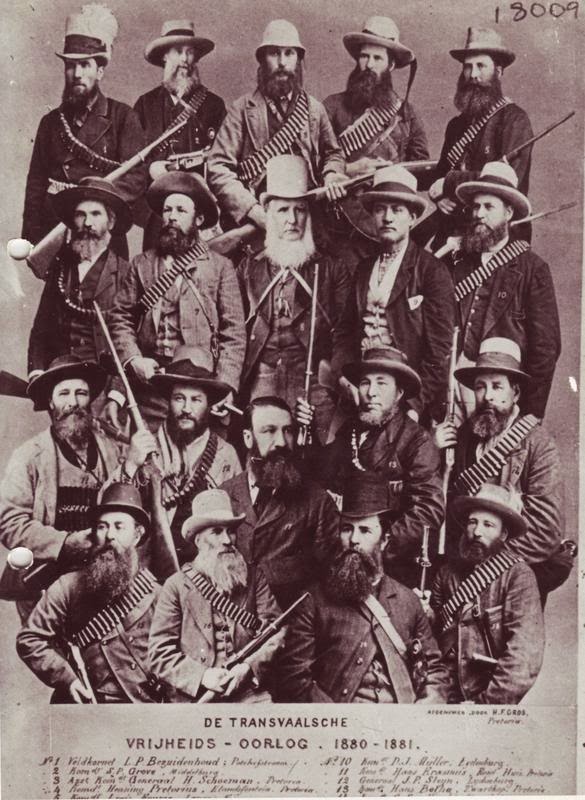
The men who took on Victoria's soldiers.
The men were:

Back Row:
1. Veldkornet L.P. Bezuidenhout, Potchefstroom
2. Kmdt. S.P. Grove, Middelburg
3. Asst. Kmdt. Generaal H. Schoeman, Pretoria
4. Kmdt. Henning Pretorius, Elandsfontein, Pretoria
5. Kmdt. Lewis Fourie, Lange’s Nek

Second Row
6. Kmdt. H.R. Lemmer, Potchefstroom
7. Kmdt. J.D. Weilbach, Potchefstroom en Lange’s Nek
8. Weesheer J.S. Joubert, Sen., Gijzelaar te Newcastle
9. Kmdt. J. du Plessis de Beer, Wonderboom, Pretoria
10 Kmdt. D.J. Muller. Leydenburg

Third Row
11. Kmdt. Hans Erasmus, Raad Huis, Pretoria
12. Generaal J.P. Steyn, Leydenburg
13. Kmdt. Hans Botha, Zwartkop Pretoria
14 Kmdt. G. Engelbreght, Standerton

Front Row
15. Veghtgeneraal J.M. Kock, Potchefstroom
16. Veghtgeneraal Frans Joubert, Bronkhorstspruit
17. Kmdt. Generaal J.P. Joubert
18. Generaal N. Smit

19. Generaal P.A. Cronje, Potchefstroom.

The same rifles, bandoliers and clothing can be seen on a few individuals, which indicates that they were studio props and not necessarily the property of the individuals on the photos. This fact has been overlooked by many researchers, who used this set of photos when researching Boer firearms.


Passenger and Government Mail Coach (circa 1888)


'Sticking Fast' - In the Six Mile Spruit near Pretoria (circa 1888)
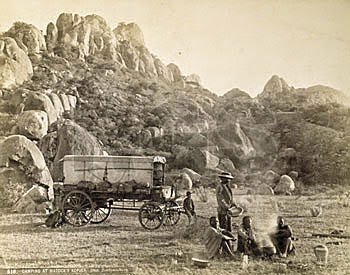
Camping at Matocks
A timbered stope - Meyer and Charlton (circa 1888).
Harry Struben is wearing the bowler hat

Knights lake at Driefontein (circa 1888).
Again Harry Struben is wearing the bowler hat.

Struben Brothers Stamp Mill (circa 1885 )
Fred and Harry Struben - Confidence Reef Mine (circa 1885)

Native Labourers working on an incline shaft (circa 1888)

Hatherley Distillery near Pretoria (circa 1888)
Botanic Garden (Witpoortjie) falls (circa 1885)

Rod Kruger with a Gros album

Sources:
Rod Kruger, Bull, Marjorie and Joseph Denfield (1970) 'Secure the shadow: the story of Cape photography from its beginnings to the end of 1870 '. Cape Town: T. McNally.
Cowan, N. (1978), 'Photograficana of H.F. Gros', 'Africana notes and news'. Volume 23, number 3, pp.99-104.
'Transvaal almanac 1877'.


Thursday, 5 March 2015

Mystery cars: Nardi Bisiluro's asymmetrical Le Mans racing car

Nardi Bisiluro's asymmetrical Le Mans racing car with
 the driver on the right, engine on the left, radiator in the middle.
  Blohm & Voss BV 141 in 1938. 
In 1938, the German airplane maker Blohm & Voss created several examples of asymmetrical bombers which, although nimble and fast, would not enjoy much success as part of the Luftwaffe. Several years later, an Italian, Nardi Bisiluro would use the idea to his advantage, this time on four wheels...


Never lacking imagination, but often lacking the financial means, Enrico Nardi continued his quest to evolve the car from its first appearance in 1932. Considering the 24 Hours of Le Mans as the only event worthy of showcasing his ideas, he took on the challenge of beating French auto-makers Renault and Panhard in their favourite class of engines smaller than 750cc. After a debut cut short in only the second lap in 1954 (water pump), he returned the following year with an ambitious project, thanks to a unique perspective.

Rather than adapt the exterior forms to the chassis, why not design the ideal bodywork first, then adapt the rest of the car to it? Following this logic, Enrico Nardi hires engineer-architect Carlo Mollino to design a very aerodynamic car, with a radiator in the middle, which he sees as a wing. He then added all the essential elements to make the car totally asymmetrical, with two fuselages. The left side housed the engine and transmission while the right side carried the driver, who needed to be small in stature.


The middle section was equipped with an
air brake... or a jumpseat ! 


The tight quarters in the cockpit necessitated
a very special steering wheel for the time.
To improve the braking performance, the car was equipped with an aerodynamic flap in the center. The ingenious air brake unfortunately (or fortunately, depending on your view) was replaced by a jumpseat (!) on the eve of the practice sessions, as the rules required a passenger seat in the car. Another innovation, the radiator was comprised of rectangular tubes aiming to disperse the heat thanks to the air flowing through them. Thre rest of the car was made up of various vehicles: Lancia Appia or Fiat 1100, with the entire weight totally only 400 kg.

The Nardi Bisiluro at Le Mans
During practice for the 24 Hours of Le Mans, the Nardi Bisiluro shows great speed (220 km/h) and performs very well in its class. Despite that, the drivers are worried to even turn around in the cockpit as the car requires a very soft touch due to extreme sensitivity to any change of direction. Even worse, they have a difficult time driving the car in a straight line! Their fears would come true in the race when after only 148 minutes, the  Bisiluro driven by Damonte is overtaken, or rather "blown" over by a Jaguar...

Retrieved from the ditch without much harm done to car or driver, the  Nardi Bisiluro would spend the rest of its days at the National Science and Technology Museum ‘Leonardo da Vinci’, in Milan.